

To know thyself is to know both your internal processes as well as the cultural waters in which you swim, and to let curiosity and boredom spurred by rigorous play (rather than willpower) guide you towards what’s actually yours to live. This is a part theoretical & part practical field report made from the middle of that process.
This one’s quite dense, and so I’ve made an outline (the next heading) that’ll hopefully help you track all the moving pieces! The transcript also contains the diagrams, if you’d like a closer look.
Everything referenced is listed at the end.
Heartfelt thanks to Carmen for your feedback!
Corrections:
In the Shklovsky section, the first part of the quote is actually from Danielle Dutton. Shklovsky did write the second part: “Art exists that one may recover the sensation of life, it exists to make one feel things, to make the stone stony.”
Episode links:
Youtube:
On wherever you listen to your podcast as “thinking out loud” (Spotify, Apple, Pocket Cast)
Find me elsewhere:
everything: https://linktr.ee/vincent_li
writing: https://substack.com/@vincentli
personal site: https://vincentli.space/
twitter: https://x.com/vincent_yc_li
Outline
Intro
process over product + finding our deepest beliefs through felt contact
The life-long values that drive you
final ends
final ends are our irreducible beliefs
ecosystem of final ends
what runs us is what we cannot see
the belief diagram
vitality of beliefs: alive vs. dead
a belief can die through habit alone
source of beliefs: internal vs. external
adaptive preferences: what we desire changes based on what we can get
the diagram are diagnostic lenses
Seeing the invisible beliefs that run us
the invisible beliefs we inherit
the sacred & the profane
we treat other’s self as a little god, and act accordingly
friction-chasing: where the suppressed self points
the invisible beliefs we inhabit
the holy cows within us: unquestioned ways we perceive
meditation: dehabituating reactivity
emotional friction is where the gold lies
resources for untangling emotional knots
art as tool for self-investigation
befriending the unoriginal, the psychotic, and the obscene
Greatness through curiosity, not self-coercion
curiosity & boredom as compass
okay, but how do you actually find your final ends?
when you simply don’t know what you want
curiosity as drive, boredom as clarification
research is what happens when curiosity meets the unknown
why willpower is not enough and what works instead
winning the nobel prize through piddling around with the wobbling plate
greatness does not come solely from pushing yourself into it
willpower of the head, willpower of the heart
attention as mechanical, scarce resource vs attention as blooming, growing process
the cure to addiction is a life worth not escaping
orthodox priest on lust: don’t fight sensuality with anti-sensuality
why did most Vietnam war soldiers give up heroin spontaneously
paying careful attention to what enlivens you
unfolding over imposing
Disciplined play to change your life
yin & yang
constraints are not the enemy of creativity
discipline is not a lack of freedom, but a harmonious relationship with time
playful rigorous experimentation
morning pages as a laboratory
social anxiety experiment: leave 5 conversations
why morning pages over other journalling practices?
realizing writing wasn’t actually my medium
changing your life through intentional playful experimentation
constraints are both subtractive and additive
heat sinks: solving procrastination
building instinct and self-trust to successfully pursue your true desires
Recap & outro
Timestamps
00:00 - [Intro]
00:18 - process over product + finding our deepest beliefs through felt contact
00:42 - [Chapter 1] The life-long values that drive you
00:53 - final ends are our irreducible beliefs
01:09 - ecosystem of final ends
01:25 - what runs us is what we cannot see
01:54 - the belief diagram
01:59 - vitality of beliefs: alive vs. dead
02:17 - a belief can die through habit alone
04:00 - source of beliefs: internal vs. external
05:09 - adaptive preferences: what we desire changes based on what we can get
06:11 - the diagram are diagnostic lenses
06:26 - [Chapter 2] Seeing the invisible beliefs that run us
06:33 - the sacred & the profane
06:58 - we treat other’s self as a little god, and act accordingly
08:42 - friction-chasing: where the suppressed self points
10:13 - the holy cows within us: unquestioned ways we perceive
10:37 - meditation: dehabituating reactivity
12:48 - emotional friction is where the gold lies
13:28 - resources for untangling emotional knots
14:01 - art as tool for self-investigation
15:18 - befriending the unoriginal, the psychotic, and the obscene
15:47 - [Chapter 3] Greatness through curiosity, not self-coercion
16:07 - okay, but how do you actually find your final ends?
16:46 - when you simply don’t know what you want
17:06 - curiosity as drive, boredom as clarification
19:12 - research is what happens when curiosity meets the unknown
19:44 - winning the Nobel Prize through piddling around with the wobbling plate
20:31 - greatness does not come solely from pushing yourself into it
21:08 - willpower of the head, willpower of the heart
21:19 - attention as mechanical, scarce resource vs attention as blooming, growing process
21:54 - the cure to addiction is a life worth not escaping
22:18 - orthodox priest on lust: don’t fight sensuality with anti-sensuality
23:12 - why did most Vietnam war soldiers give up heroin spontaneously
24:59 - paying careful attention to what enlivens you
25:14 - unfolding over imposing
25:58 - [Chapter 4] Disciplined play to change your life
26:16 - constraints are not the enemy of creativity
26:21 - discipline is not a lack of freedom, but a harmonious relationship with time
27:18 - playful rigorous experimentation
27:50 - morning pages as a laboratory
28:43 - social anxiety experiment: leave 5 conversations
30:25 - why morning pages over other journalling practices?
30:50 - realizing writing wasn’t actually my medium
31:54 - changing your life through intentional playful experimentation
32:24 - constraints are both subtractive and additive
32:59 - heat sinks: solving procrastination
34:37 - building instinct and self-trust to successfully pursue your true desires
35:22 - [Recap & outro]
Transcript
Intro
Hi, welcome back to Thinking Out Loud. I started this year with a goal of trying to make more creative work, which has led me down this exploration of play and experimentation, and also in this digging deeper, trying to uncover what really drives me underneath all of this. I want to give you a theoretical and practical field report on two ideas, the first being creating the right process can matter more than obsessing over the right output, and the second of how long-standing values can come not from being imposed, top-down, and followed, but rather found and felt for right fit, bottom-up, through being tested against the world.
The life-long values that drive you
Final ends
We’ll begin with that last question. How do you figure out what matters to you, those most distilled and foundational reasons that drive all that you do? Aristotle talks about these as the telos, the final ends, them being final because you can’t reduce your reasons further beyond this. These become the things that are pursued purely for their own sake, rather than for some even deeper reason.
Whereas Aristotle believed that we have one ultimate final end, eudaimonia, Elijah Millgram believes that we instead are constructed from a multiplicity of final ends that evolve, change, and even compete with each other over time.
On top of this, when we begin to try and find what our final ends are, we run into one big problem, which is that so many of our beliefs are so ingrained in us that we have a hard time seeing what they are. It’s a bit of a fish-in-the-water sort of situation, despite them having a tremendous influence over us, over our actions, over how we perceive the world, what we care about and what we put our time and attention towards.
The belief diagram
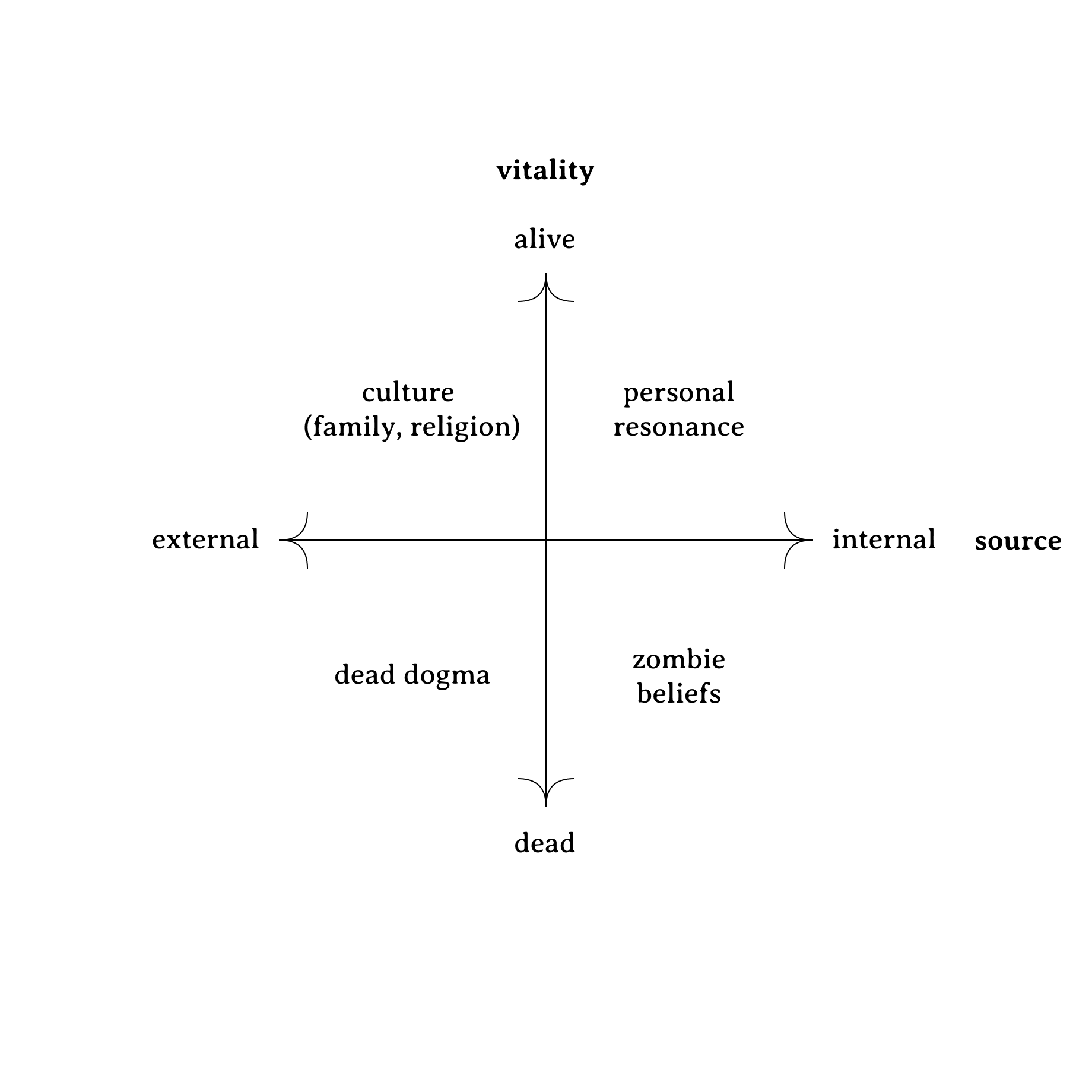
And so to help with this, I came up with this chart to categorize some of our beliefs. The axis of the vitality of beliefs is about how those beliefs influence us.
Beliefs that are alive are embodied living truths. They are beliefs that actively shape how we are in the world, our actions, our thoughts, what we care about. Beliefs that are dead have become rote and habitual. And I mean dead in a trickier sense than just the fact that we no longer believe in them, but rather these are beliefs that we may still say that we hold, but that because they have become so habitual, they no longer have any influence over our actions.
Because of this, they no longer truly animate us. They have become things that we go through the motions of. An example of this may be somebody who starts volunteering at a food bank because they really care about alleviating suffering, this alleviation of suffering being a final end for them. And so they show up on Saturdays to start packing boxes of food.
In the beginning, they see the faces of those who they’re serving and feel spurred by this, feel the moral weight of their actions and are energized. However, you can imagine after a couple of years, they still show up at the shifts. They still pack the boxes, but there is something that has changed. Their internal relationship to this has hardened.
They will still tell you that they really believe in the alleviation of suffering, that this is why they still show up, but that sense of conviction, that embodied feeling of why this matters to them has been lost. Their belief is no longer truly present in their experience. The habituation has led to this work feeling mechanical, and although they still hold this belief, the final end no longer sustains them. The belief has become dead.
Before we begin discerning the vitality of any particular belief, we first have to be able to see them as a whole. The external and internal axis, this source of belief, helps us see where they come from. External beliefs are inherited through culture, and so this could include something like your parents as well as any kind of community that you’re a part of, whether that’s your university, a religion that you’re a part of, or even that friend group that you’ve been a part of for a really, really long time. For instance, Christianity has a whole set of beliefs that it has its believers take on, and these beliefs that I’m talking about, again, aren’t just ideas in our head.
These are things that move us, that we really embody. Internal beliefs are beliefs that have personal resonance, and is typically something that is discovered by us, rather than just taken on from a culture that we’re a part of. For instance, these are beliefs that could come from reading a book, or through a really good conversation, through experience, or specific, very inspirational individuals. This distinction is not clean, it blends.
For instance, the external will influence the internal. Jon Elster, the social philosopher, talks about this in terms of adaptive preferences. This can really be described through the fable of the fox and the grapes. There is a fox who comes to a grape tree, and wants to get this grape that is very high on a branch.
He tries a couple of times, jumping to try and get it, and failing, and eventually he gives up. As he’s walking away, he mutters to himself that the grapes were sour anyway. What we desire, what we value, changes based off of what we can realistically get. For instance, if, systematically, women are blocked out of the workforce, their desires will begin to shift to prefer domesticity.
More personally, and I’m sure you’ve seen some example of this, if somebody cannot get somebody else romantically, eventually, over time, they may see them more and more as unattractive, as somebody who weren’t suitable for them anyway. I want to emphasize here that this isn’t about external beliefs being bad and internal beliefs being good, but rather just as a way to diagnose and to see more clearly where our beliefs are coming from, what beliefs we hold.
Seeing the invisible beliefs that run us
The invisible beliefs we inherit
More practically, a way to begin to spot those external beliefs is through ritual. Émile Durkheim, the father of sociology, talks about religion as being born out of the experience of the sacred and the profane realms and the movement between them. The sacred is that which is powerful, external, set apart, prohibited, charged. And the profane is that which is the mundane, the everyday, the diffuse. Erving Goffman, a sociologist that came after Durkheim, built on his idea and began to see how in modern society we treat the individual self as a little god.
And this can be understood through two kinds of rituals that we do, avoidance rituals and presentational rituals. Avoidance rituals are about not profaning the sacred. This includes not intruding on somebody’s personal life uninvited, not touching them without permission, not bringing up topics that would embarrass them, not staring at them. You treat the other person’s individual self as something that could be contaminated without a proper protocol of approach.
Presentational rituals are the positive side of that. This is the active honoring of that little god. This shows up in things as small as greeting someone when we see them. This is an acknowledgment that their existence matters.
This also includes asking them how they are, laughing at their jokes, paying attention to them when they speak, complimenting them. All of these things are small offerings at the altar of their selfhood. Even when somebody does have authority, notice how they begin to couch their terms in a much more deferential way. For example, a boss, rather than issuing a direct command, might say, hey, when you get the chance, could you please maybe take a look at this?
There is an honoring of the subordinate itself, even while exercising direct power over them. I bring these examples up so that you can begin to use them as a kind of structural analogy to places in your own life. A way that I like to begin investigating this line of thought is through this idea of friction chasing, which is to investigate the places where you run into internal friction or resistance, where things don’t feel quite right. They feel inhibited.
You flinch away from them. You cringe at them. For example, if you imagine how you are in one friend group versus another, which parts of you become highlighted, which parts of you feel easily expressed, and which parts of you don’t, which parts of you stays hidden, stays a little strange if you were to bring it up in that environment. The parts that you suppress, that is a point of friction.
And by beginning to investigate that, you begin to see the differences in culture and you begin to spot what are those rituals that you’re always operating under? What are those invisible constraints that shape your behavior and shape what you value? This can come through things like, is there a group of friends that you feel comfortable complaining as default, but feel quite uncomfortable when you do have good news to share? As you begin to see the differences in how you show up, those places where you stay consistent that draws a through line through all of the different selves that shows up in different environments, those pieces can also begin to point to the final ends that you hold.
The invisible beliefs we inhabit
And so that question of what we’re treating as sacred in a culture can also be turned internally. We can broaden this by thinking about it in terms of habitual perception. What are the beliefs and ways of seeing the world that we don’t question, that we don’t touch? Or perhaps at a more fundamental level, are unable to question because we’re not even able to see them.
We can think about one part of meditation as working directly with this capacity to be able to see our habitual responses, to create a gap between an event and our reaction to that event so that we have more choice. David Chapman puts it in this sequence.
Something happens. So for example, a car cuts into your lane while you’re driving.
You perceive the event. And so you see the car and you slam on the brakes.
You immediately interpret it. That guy is a selfish, reckless asshole that almost caused me an accident. He just disrespected me. He shouldn’t be on the road.
An emotion arises based on the meaning that you gave the event. Anger. Your hands grip the wheel tighter. You feel a flush in your chest.
The energy of the emotion demands action. There’s an urgency there. There’s a sensation that you have to respond in some way. And finally
You do something that feels mandatory based off of your emotional interpretation. And so you honk, you tailgate them, you drive quicker than them to cut them off. You rant about it to your passenger for the next 10 minutes. You swear and mutter under your breath.
Steps three to six are all unnecessarily limited. There may be other ways to interpret the event. There might not even be a need to interpret the event at all.
And similarly, there might be other ways to react to the emotion. And it might be the most appropriate to not even react at all. One way that this shows up is that idea of imagining that that guy is speeding off because his wife is about to give birth to a child or there is some other kind of emergency. The reinterpretation of that same event changes our emotions to it and changes our reaction to it.
And so what meditation can do is to cultivate a kind of spaciousness, a spacious freedom through which you can break our habitual patterning and to perceive freshly and act differently. One way to spot more of these moments is to return to that idea of friction chasing. When in your life do things feel like it breaks down a little bit? For instance, why did that comment at that party bother you so much?
Why does this change in routine feel so destabilizing? What are the times that you felt disoriented and confused? All of this emotional charge is a signal towards some load-bearing belief. I’ll give you a personal example at the end of this essay where I realized that part of the reason why going to parties was so difficult for me was because I didn’t know how to exit them.
But this principle goes very very deep and in fact some of our best emotional and therapeutic modalities work exactly with this idea of investigating where your emotional resistances come up. If you would like to learn more about this I would recommend Joe Hudson’s podcast and work, Art of Accomplishment, as well as the books Power of Focusing, No Bad Parts, Already Free, and if you want something a little bit more theoretical, Unlocking the Emotional Brain. I hope that these will be good trailheads for you. Another way to begin to free ourselves from our habitual ways of perceiving is through art.
My previous video essay was on the topic of art and attention, and of how one way to understand art is that of different ways to provoke in the viewer an examination of their own psyche. As Irwin puts it, perception itself is the art act. And so art then becomes this tool for self-investigation, for thinking about and feeling into why did this thing make me feel so repulsed, and in fact what even is my relationship to repulsion? The Russian formalist Viktor Shklovsky has this really wonderful idea of art as dehabituation.
He says that the job of art is to make the world strange so that we might see it again rather than simply recognizing it out of habit. Art exists that one may recover the sensation of life. It exists to make one feel things, to make the stone stony. Good art is embodied and participatory.
And a final example I’ll give here is improv. One of the books that has impacted me the most deeply has been Impro, written by Keith Johnstone. One of my favorite ideas in there is how he talks about the most creative ideas are the ones that are unoriginal, psychotic, and obscene. Each of these are a different kind of visceral fear that we have, and one of the greatest lessons of improv is that in befriending these fears, there lies our creativity.
Greatness through curiosity, not self-coercion
Curiosity & boredom as compass
And here we come to an important question. I’ve just spent the last while talking about the ways that we can dehabituate our perception, noticing the forces that are operating on you and those obstacles that are preventing you from seeing clearly, so that you can respond with a sharp mind and from those desires that are close to your heart. However, once you’ve gotten here, how do you actually find those final ends that are yours to live? Sometimes the process of clarifying and clearing away by itself reveals them, but oftentimes we’re left without direction in the space of possibility.
One answer might be to just pick one and commit to it. Now there are two ways that this can fail. The first is that that final end may go dead on you. You can still hold on to it, articulate it, but it no longer has that driving, animating force.
We talked about this earlier with that example of the person who volunteers at the food bank. The second is that there will inevitably be times in our lives where we just simply won’t know what our final ends are, whether that’s in relationship to what we’re going to choose in college or work or our romantic relationships and so on. In these moments, we actually just don’t know what we’re looking for. To return to improv, improv requires this kind of open stance, this open curiosity towards our own internal experience, this willingness to freefall into the unknown, guided only by that explorative spirit.
If you might recall Millgram, the one who said that we are constituted from a plurality of final ends, he interestingly said that this is the answer, that curiosity and fascinatingly boredom are the ways that we stare ourselves towards the discovery of our final ends. He refers to when we’re exploring uncharted intellectual territory. In those moments, there isn’t actually a clear why behind the things that we’re doing. It could just be guided purely off of instinct, and there, the decision between why you might choose one book to read versus another is ungrounded in a final end.
In those cases, that is your curiosity at work, and if curiosity is what moves you towards something and sustains that interest, boredom is the signal of pause. It points to when something may be at your limits, when there is something unresolved. It doesn’t necessarily mean that you should just stop doing it, but that there is some kind of emotional block, some sort of signal towards a deeper motivation that is pointing to how you are right now out of alignment. Curiosity and boredom serves as these two counterbalancing forces.
One is the energy of yes, of creating possibility, and the other is that of no, one of clarification and clearing out. Both, and in particular boredom, are important to sit with, to not be swayed into some impulse to scroll your phone, because in the sitting of them is where that inner intuition lies.
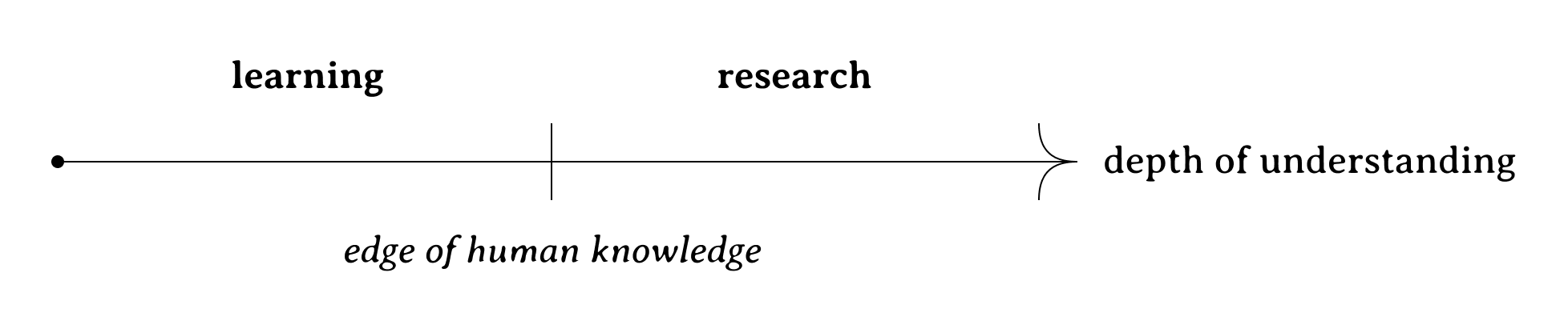
Adapted from Kanjun’s diagram
Kanjun too has this beautiful piece called Research as Understanding, where research comes not just from this process of straining hard in order to try and discover something new through the scientific process. Rather, if learning is something that happens when you’re trying to understand something that somebody else already understands, research is what happens as a byproduct of your curiosity when you chase to try and understand the things that nobody else understands yet.
Why willpower fails and what works instead
Feynman has this great anecdote in his book where he talks about how after being burnt out of doing physics, he just started to do things for the fun of it. And from that place of curiosity and play, and for no other reason than that, that eventually led to his work, which won him his Nobel Prize. He says of this process, it was effortless. It was easy to play with these things.
It was like uncorking a bottle. Everything flowed out effortlessly. Almost try to resist it. There was no importance to what I was doing, but ultimately there was.
The diagrams and the whole business that I got the Nobel Prize for came from that of piddling around with the wobbling plate. And I really want to emphasize the importance of play. I think so many of us, myself included for sure, seems to have this belief that great things can only come out of this self-flagellatory process where we push ourselves with our willpower towards greatness. Now, I’ll need a whole other video to talk more in depth about this supposed binary between discipline constraints and spontaneous creativity of how Yang structure can work well with Yin flow. But for now, I’ll start with the latter.
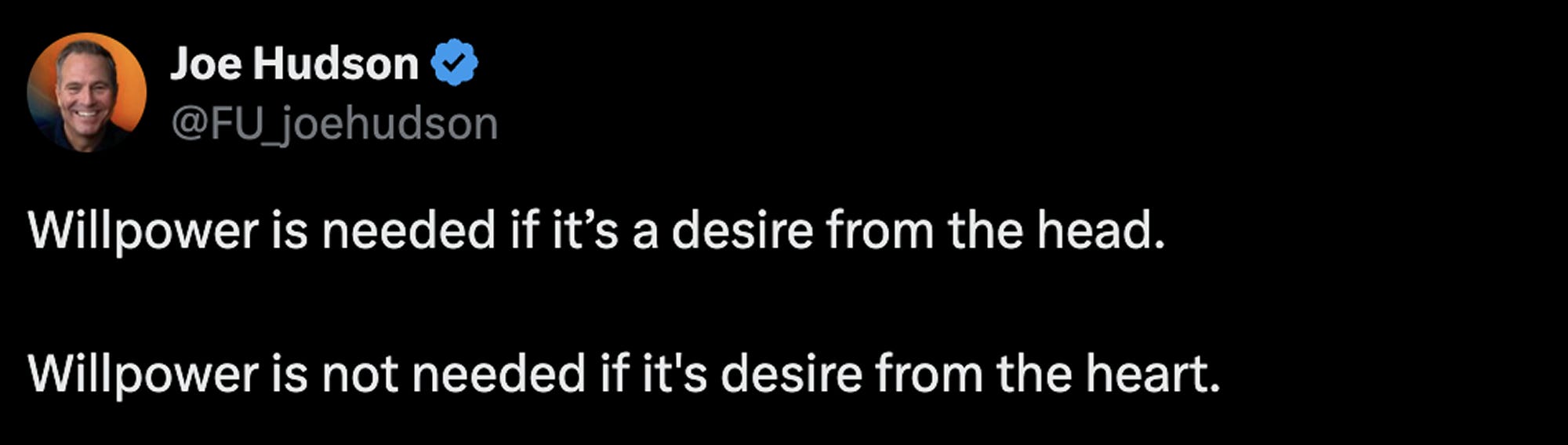
Joe Hudson, who I mentioned before, talks about how willpower is needed if it’s a desire that comes from the head, and it is not needed if it’s a desire that comes from the heart. And I think this is intuitive. We have sort of two ways that we typically think about attention.
One is attention as this mechanical process where it is a scarce resource that we have to allot carefully throughout a day. And the other is attention as this blooming, growing process where when we are in flow, it seems to naturally catch on itself. It seems to actually, in fact, grow and expand over time the deeper that we get in it. I think something that is relevant here is addiction.
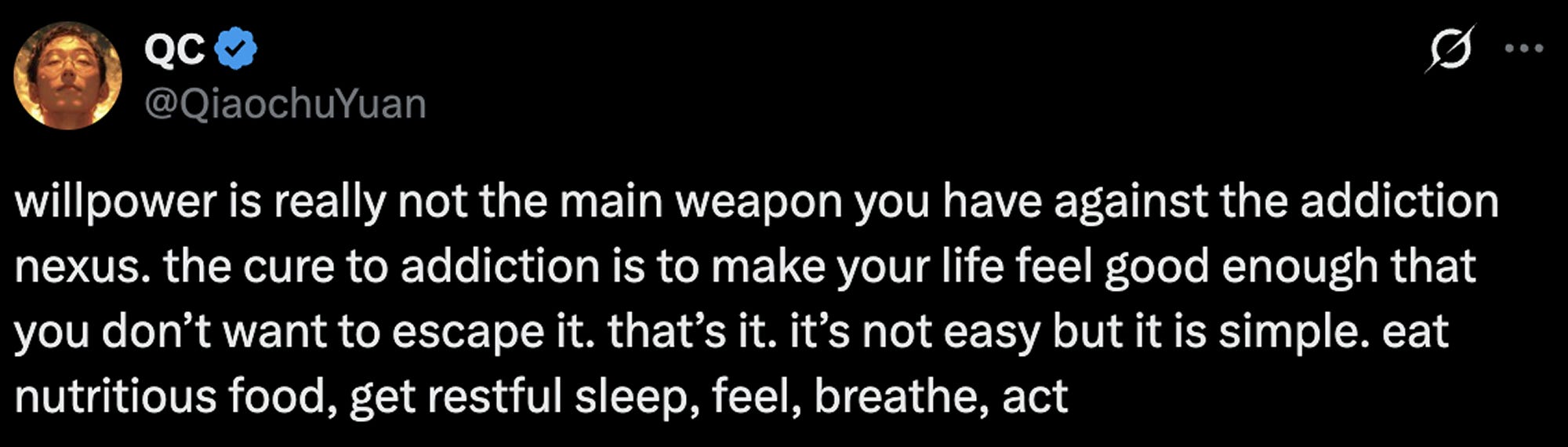
QC talks about it like this. Willpower is really not the main weapon you have against the addiction nexus. The cure to addiction is to make your life feel good enough that you don’t want to escape it. That’s it.
It’s not easy, but it’s simple. Eat nutritious food, get restful sleep, feel, breathe, act. And this has resonance across a bunch of places. I remember this orthodox priest talking about lust, where he talks about lust as this distortion of the heart’s God-given power to orient externally to service, self-sacrifice, and care for others.
And it becomes distorted when we turn that inward. And so the solve is not to fight sensuality with anti-sensuality. It isn’t actually through repression, but rather giving the heart tasks that it wants to do. And so in this case, he recommends service without self-gain.
And so, for instance, going to volunteer at a food bank, or helping the old lady cross the street with her groceries. These things begin to train the heart to open up towards these more wholesome desires that is actually much more aligned with what it actually wants. Another angle into this is Mark Lewis’s work, where he has a different frame of addiction than we normally think of it. Typically, we believe that addiction is a biophysical phenomenon, where people get dependent on some kind of chemical, and the absence of that chemical creates that craving towards it.
If we don’t get chemical, we suffer in the same way as though we are lacking food. Lewis says that unfortunately this model isn’t complete. For instance, a lot of people spontaneously give up their addictions in their 30s. And a bigger historical example of this is through the Vietnam War, where in Vietnam, soldiers get addicted to opioids and heroin, but when they return to the US, the vast majority of them actually just give it up spontaneously.
And so if there isn’t that chemical in the body, why is there not that compulsion? The answer is actually quite similar to what we were just talking about. What kinds of rituals that we’re operating under, the cultural environments that we’re in, the people that we spend our time around, have a real influence over who we are. And Lewis talks about it in a similar way.
He talks about it as this sort of agent to arena relationship, where a soldier in Vietnam is a very, very different self and environment coupling than a civilian in a peaceful country. Beyond this, how you create a good environment, both externally and internally, then clearly has a huge influence over your ability to see yourself clearly and to pursue the things that enliven you. More than that, if you pay careful attention to what enlivens you, to what captures your curiosity and attention, and build your life such that you can follow them over time, you will begin to build a life that is powerfully and uniquely yours. Henrik Karlsson talks beautifully about this process.
In his essay, Everything That Turned Out Well In My Life, followed the same design process. In it, he talks about how you can get to what you want, or perhaps better put, what works for you in particular, not through imposing a top-down fantasy, but rather working in this attuned design and action process that unfolds you into being in the career, the relationships, the experiences that you want. This is very much in resonance with everything that we’ve been talking about so far. In that essay, he gives many great suggestions and questions in order to help you enter into this process of unfolding yourself.
Disciplined play to change your life
Yin & yang
Building on top of that, I want to give some suggestions for how to balance this bottom-up creativity with top-down discipline, this yin and yang, through disciplined play as rigorous experimentation. It’s done not through hindering the creative process, but rather setting up the environment, the constraints within which creativity can flourish. Rick Rubin noted the same thing in his book, The Creative Act. In it, he says that consider establishing a consistent framework around your creative process.
It is often the case that the more set in your personal regime, the more freedom you have within that structure to express yourself. Discipline and freedom seem like opposites. In reality, they are partners. Discipline is not a lack of freedom, it is a harmonious relationship with time.
Managing your schedule and daily habits well is a necessary component to free up the practical and creative capacity to make great art. It could even be said that a focused efficiency in life is more important than one in work. Approaching the practical aspects of your day with military precision allows the artistic windows to be opened in childlike freedom. Like how I talked about those presentational and avoidance rituals, I want to take these suggestions that I’m about to give you, these examples, as that.
As these frameworks within which you can build off of, play with, break and riff on. They are very much provocations for you to see how you might adapt it into your own life, into your own creative process. To help inspire a seeking of the forms of discipline and structure that work well for you.
Playful rigorous experimentation
This has taken form in the shape of morning pages, which was created by Julia Cameron. I didn’t understand experimentation until I had this space where every single morning I was forced to write at least 750 words. This is an alteration on the original format of writing by hand for three pages long, but I knew myself enough to know that if I were to do it in the original format, it would not stick. It would be way too laborious.
And so I adapted it to this digital form and instead kept track of it by word count. Now what this did was to give me the space to recount not just what happened in the day, but because I had to keep on writing to begin to analyze it in detail. It led me to begin to dissect, reflect and chart forward new paths. For example, this process has been really helpful in making me understand my social anxiety better.
How it happened for me was I would go to a party the previous night and then the next morning I would begin to reflect on it. What went well, what didn’t, and in fact, what even is an interaction? And in there I broke it down into three stages. The entry, the conversation itself, and then the exit.
With this framework, I could see that I was doing okay with the conversation. I struggled some with the entry, but where I really got stuck was the exit. I didn’t know how to exit conversations in a way that felt good, in a way that didn’t make me feel awkward or feel like I was disrespecting somebody. This helped me see really clearly that one of the reasons why I had that social anxiety was because I did not trust myself to exit well.
I didn’t trust myself to actually leave when I felt uncomfortable, when I felt bored, when I felt like I just wanted to be somewhere else. During the next morning pages, when I had an upcoming gathering that night, I came up with an experiment where I deliberately worked on exiting interactions whenever I got bored or tired, and I set myself the goal of exiting five conversations. This actually was fantastic. It gave me this embodied sense of evidence that I could actually take care of my own needs, that I was actually capable of moving myself to where I want to be.
Needing to hit a word count was absolutely crucial for me. I’ve tried other journaling practices over the years, and none of them have stuck. But there’s something about being pushed to the edges where it just didn’t feel like I had anything else to say, but needing to still write. That sitting with that space of boredom began opening up this deeper form of investigation.
The next example is not something that I realized through the morning pages, but is very much the kind of thing that I’m investigating in there. I’ve been trying to write for some years now, and it’s been this stop-start process where again, nothing has really stuck. It was only recently that I thought to question if writing was actually even the right medium for me. And in that questioning, I got to thinking, what was it that I wanted to get out of writing?
And were there other forms, other mediums that could better serve that process, that was actually better fitted for me? And through that, I realized that actually, speeches and presentations were my preferred format for much of my life. And so this is how I landed on these video essays, which has so far been exactly what I needed. It required me to not be so tunnel vision on writing, to begin to question why I was so attached to this idea of writing.
And through that process, be able to consider what did I actually want out of it? And are there other ways to achieve those same underlying desires? And so this ability to be able to take a step back, and more importantly, to be able to track this over time, to have a place where I am actively building on top of what I learned and what I recognized and saw the days before. These are all the ingredients that have made Morning Pages such an effective laboratory for me.
A place where I can take apart my life analytically, and then be able to play with them in a very intentional way. Some other experiments that I’ve been running with the Morning Pages have involved shaping what options are available to me. You see, a constraint is both something that removes optionality, for example, limiting the use of social media on my phone to five minutes a day, but it can also be done through adding something. This Morning Pages practice itself is a great example of that.
If the very first thing that I do in the morning is to open up my laptop and begin typing, then during that time, I can’t look at my phone. I can’t be on Twitter and scrolling. Another way that I’ve been approaching this question of shaping my options is through trying to solve procrastination for myself. I realized that there was a sense that this in-between state, where I get caught by something, is the same when I’m procrastinating on doing some work, as it is when, for some reason, hours of my day just disappear, and I’m left at the end kind of dazed and completely unsure as to what I spent my time on.
And I realized that this came from me trying to avoid some uncomfortable or difficult emotion, or where the excitement of doing something that I actually want to do has a lot more friction than simply going on my phone. I like to think about this dynamic in terms of heat sinks. Heat sinks are these places in thermal systems where if you have excess heat, you have to dump it somewhere. You have to move that excess energy.
In the same way, when I have this excess energy in my emotional system that I can’t handle right now, it has to be dumped somewhere. And so, in this analogy, phones are one heat sink. But there are heat sinks which leave you feeling more energized afterwards than more drained. Instead of leaving an emotionally compromised Vincent to figure that out, to figure out which heat sinks he wants to do that will leave him feeling more rejuvenated afterwards, this is something that I can begin planning out ahead of time in my morning pages, and then during the day actually test out and see if they work as I want them to.
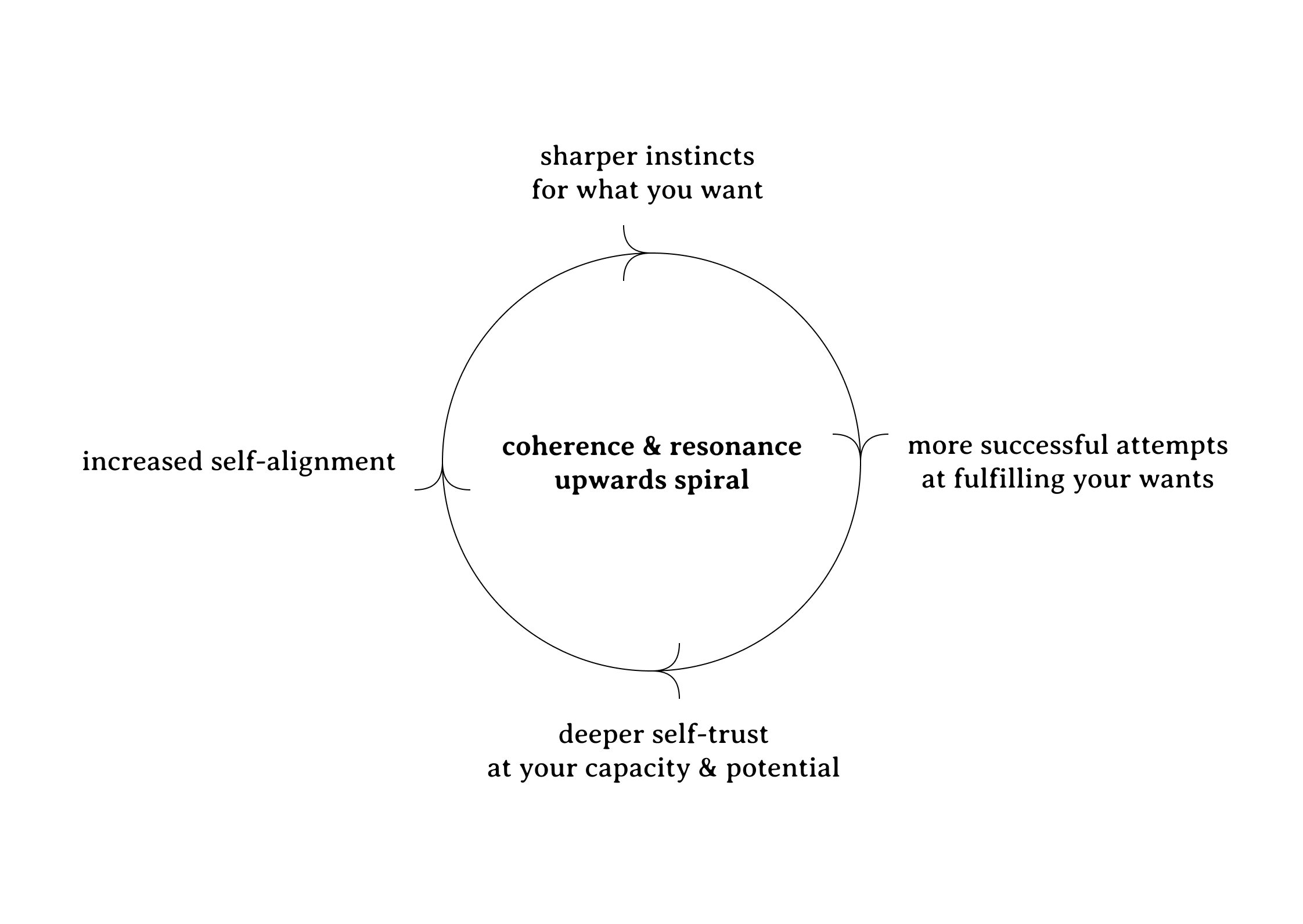
Much of this is not only about finding what works for you, but also about building an instinct around your true desires, as well as a self-trust that you are able to pursue and fulfill what you actually want. The more that you’re able to successfully do what feels good to you, the more you become self-aligned, and in that, you’ll loop back around. to be able to notice more and more sharply the things that you actually want to do. It tightens that feedback loop between you doing something in the world and getting feedback that your instinct around it was correct or not. And then over time, as you begin to track and begin to change and evolve and iterate, you’re able to hone that instinct better and better.
Recap & outro
And so we just covered a lot. Let me do a recap. The first was to investigate what prevented us from seeing and feeling clearly what we already value. I gave the model of the belief diagram, with one axis being the source of belief, the internal or external source, and the other being the vitality of beliefs, from dead to alive.
These were presented as one way to help make visible the invisible structures that are constantly influencing us. After giving some tools for dehabituating our perception, we then talked about some ways to find those final ends, not through rigidly following some imposed or constructed top-down structure, but rather through this bottom-up process of being guided by curiosity and boredom, to stare us through the times when those final ends are uncertain. After that, we covered some more practical details around that bottom-up process, of the importance of play, of tuning into those things that make you feel alive, balanced with a more rigorous structure that turns those freeform explorations into experiments that can build on itself over time, through being in very conscious contact with the feedback loop between yourself and the environment that you’re in.
As I’m still in the middle of all of this myself, I would love to hear about how this stands for you, and to hear about any of the experiments that you’ve been already running in your own life. And so, until next time, take care.
References
People & works referenced
Aristotle on telos
Elijah Millgram. One of the main inspirations for this video essay came from his essay “On being bored out of your mind” - he doesn’t talk about the multiplicity of telos there, but does talk about curiosity and boredom
Jon Elster on adaptive preferences
Émile Durkheim on rituals and the sacred & the profane
Erving Goffman on the individual self as little god via avoidance rituals and presentational rituals
David Chapman on meditation and spacious freedom: https://vividness.live/spacious-freedom
My previous video essay on art and perception:
Viktor Shklovsky, from Danielle Dutton’s “A Picture Held Us Captive”. H/T Sundus for surfacing it, see fuller quote here:
Keith Johnstone, Impro. “unoriginal, psychotic, obscene”
Kanjun Qiu, Research as Understanding:
Richard Feynman, Surely You’re Joking, Mr Feynman! (I haven’t actually read this book, but the excerpt comes from there. Highly recommend seeking out the full excerpt)
Joe Hudson on willpower:

QC on addiction:


Bishop Irenei on lust:
Marc Lewis on addiction as not just chemical (learnt from John Vervaeke’s Awakening from the Meaning Crisis series)
Henrik Karlsson, Everything that turned out well in my life followed the same design process:

Rick Rubin, The Creative Act (have only read bits and pieces)
Julia Cameron, The Artist’s Way (have only worked with the morning pages practice)
Understanding internal resistance
Joe Hudson’s Art of Accomplishment - his Twitter is great, as is his Youtube channel and podcast
Power of Focusing (better introduction than the canonical “Focusing”)
No Bad Parts (great on IFS, just ignore his understanding of the “self” in meditation)
Already Free (western therapy in dialogue with meditation)
Unlocking the Emotional Brain (underlying mechanism to all effective therapy)


