
The flourishing and fracturing of meaning in culture's endless search for the hyper-personal
arthurian legends, darker & grittier, evolution of media, myth to individual, laws and saints, model for the decline of media literacy, tiktok cores, orienting towards a fractured culture

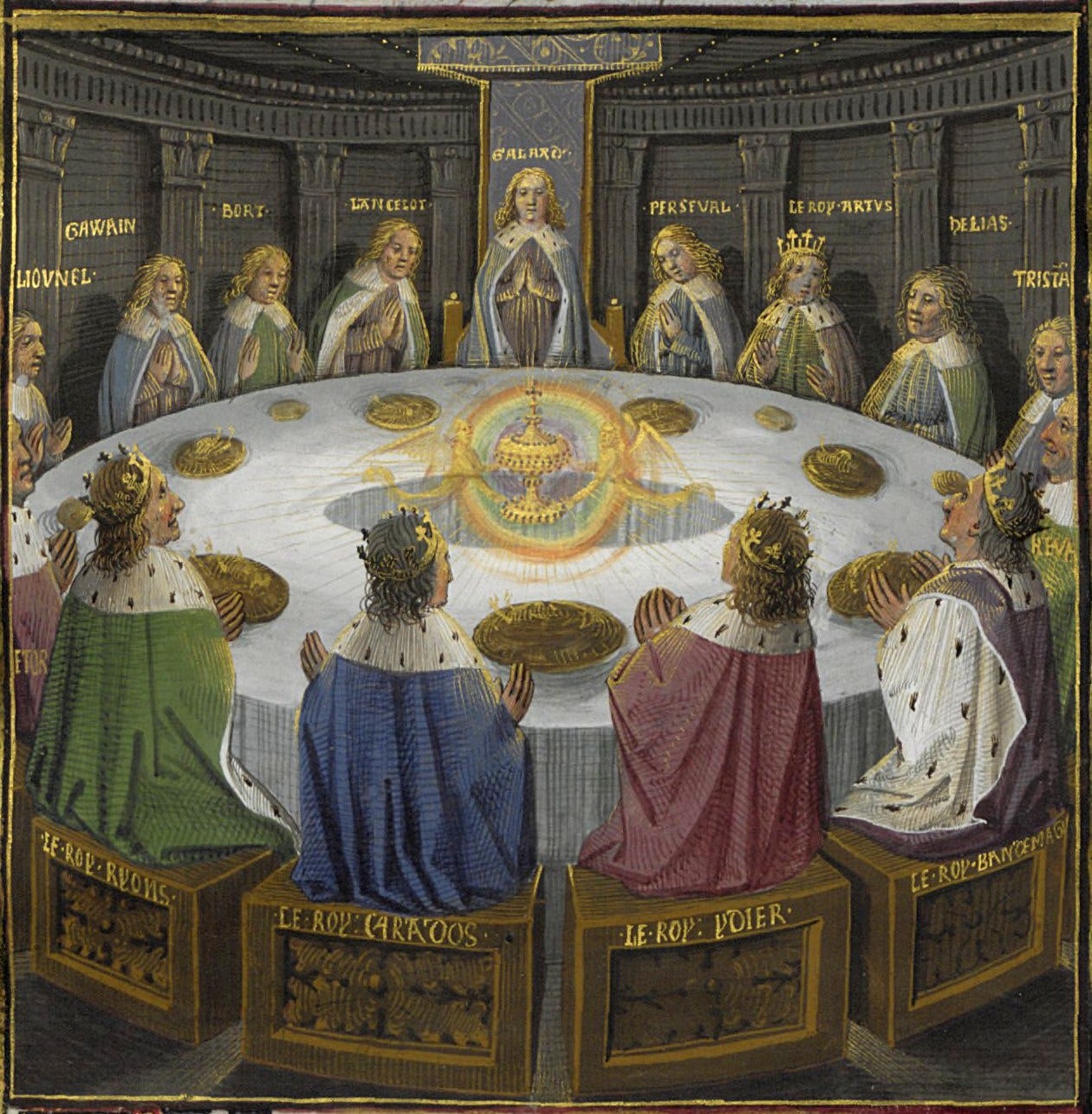
Évrard d'Espinques, The Round Table experiences a vision of the Holy Grail, 1475
When I read the Arthurian legends some months ago (King Arthur, knights of the Round Table, the Holy Grail, etc), I was surprised by how textured they were, filled with yearning and betrayal and grief. I had thought they were mostly simplistic fairytales of damsel saving and dragon slaying (which, to be sure, of the first there were an abundance, though of the second, few), but they’re better considered as how they were in the medieval ages: the Marvel Cinematic Universe, with endless new adventures, spin offs, reboots.
A tendency of perception and understanding is to start at the level of caricature. When we encounter something new, it’s often taken in through a symbol / archetype (some lower fidelity metaphor or abstraction to bridge understanding), and only after repeated time, the nuance and multiplicity integrates. This is particularly pronounced in technology: cars were first horseless carriages, electric light as artificial flame, your personal computer having a ‘desk-top’ with a ‘trash can’ and ‘folders’.
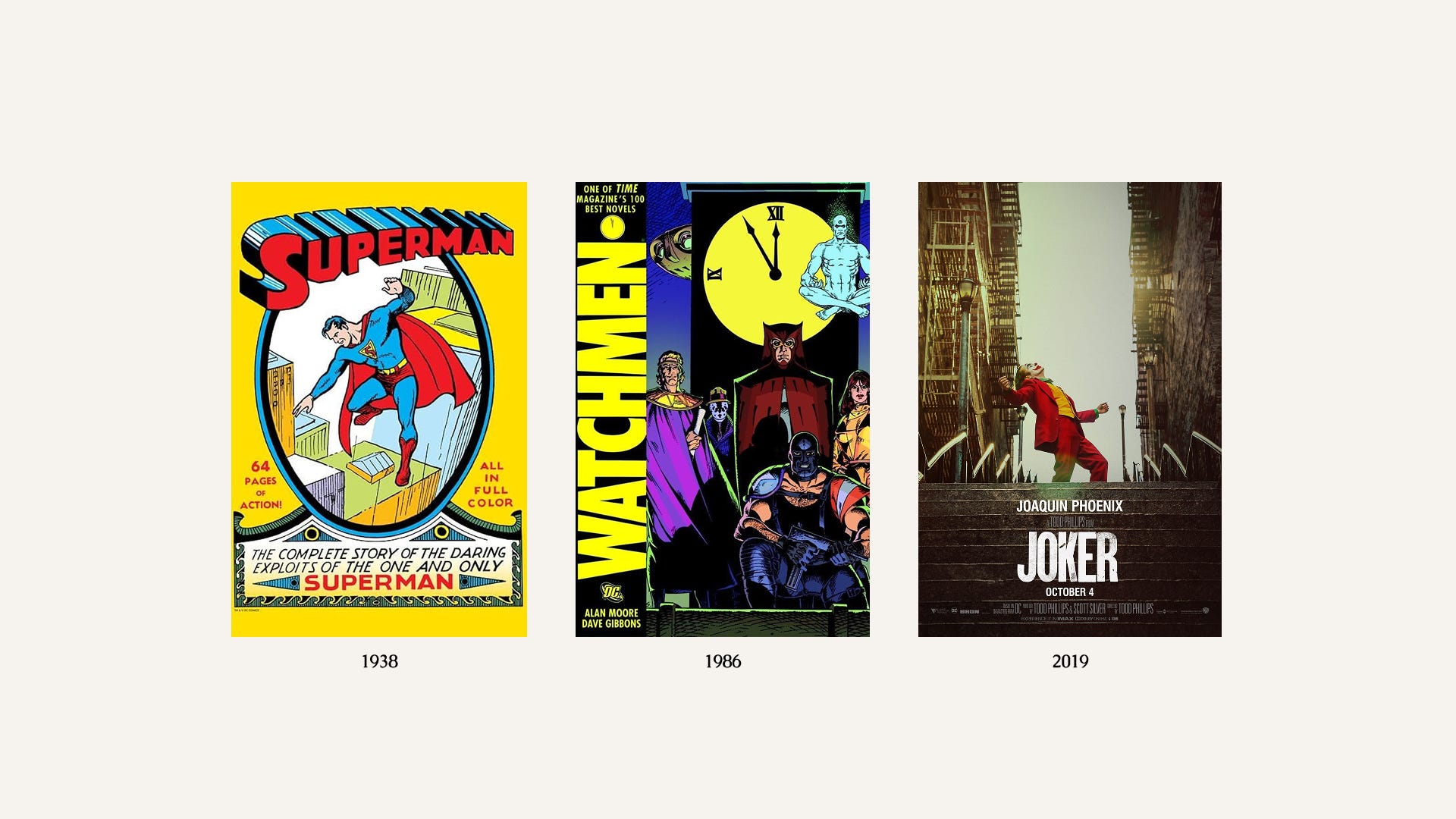
Comic books evolved similarly, where it begun with infallible, morally clear cut superheroes like Superman and Captain America. The continuous move towards ‘darker and grittier’, with morally complex heroes and multidimensional, even sympathetic villains, come from a desire to refine the earlier, simplistic structures into one that pulls closer towards the messiness and ‘humanness’ of our real, day-to-day experience.
In parallel, recorded visual media has evolved from:
a translation of theatre into film with the mirrored ways of approaching acting (symbolic)
to more naturalistic method acting (e.g Marlon Brando)1
to TV series and sitcoms (which interestingly, method acting and I Love Lucy (one of the first major sitcoms that established the format) both gained popularity in the US around the 1950s)
to reality TV (e.g Survivor)
to the Youtube era of Let's Plays (which I think is distinct enough to be a new cultural form, but that's for another essay) and vlogs (e.g Casey Neistat)
to short form video (i.e TikToks; Vine heralded it but seems to have primarily operated in the meme space, whereas we’ve now rapidly explored the possibilities into a wide range of fascinating new formats).
Attending this shift is also a change from centralized television and news (I mean once upon a time we had ‘the most trusted man in America’ who was a journalist! Could you imagine that been a possibility now?) and centralized taste from curators (that scene about the cerulean sweater in The Devil Wears Prada is an excellent gesture towards the power and influence that magazines had), to decentralized opinions of individual influencers whom you follow (we can argue about how decentralized their opinions really are, but the attitude towards centralized media and single narratives have certainly changed).
In a completely different field, if you squint, the historical and doctrinal progression of the Buddhist vehicles from the renunciation and transcendence of Sutra (clearly defined paths and maps, unified flavour of enlightened arahats) into the immanence and integration of Tantra (hyper personalized 1:1 instruction, huge range of enlightened tantrikas) reflects this too.
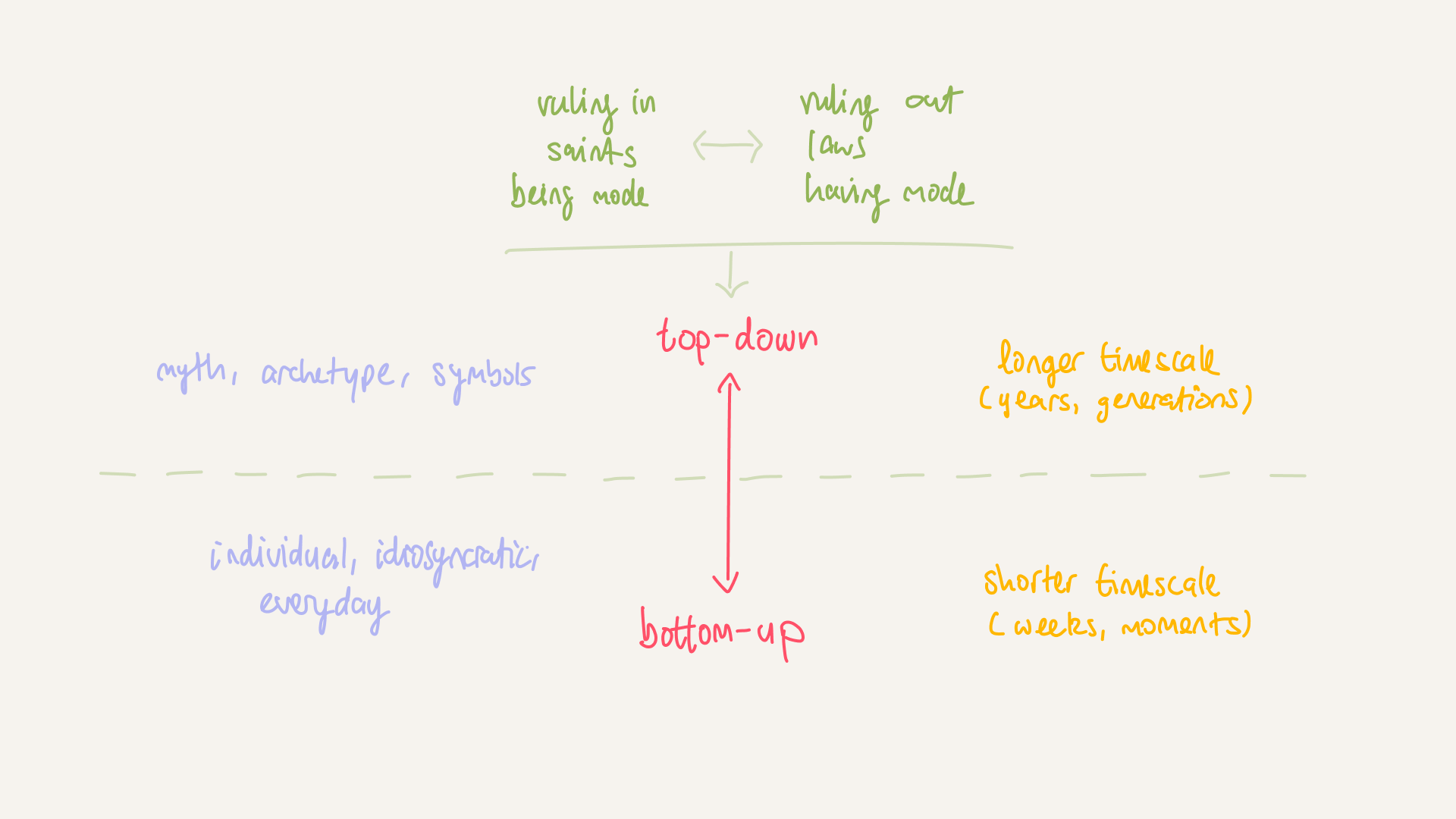
So broadly, there's the top-down structure of myth, archetype, and symbol, and the bottom-up structure of the individual, the idiosyncratic.
In thinking about the top-down, ancient roman rule had two kinds of power or authority: ruling out, and ruling in. Auctoritas was ruling out. This is the police, the law — the explicit set of things you're not allowed to do. And then you had potestas, which are the role models and the people of virtue whom inspired you to become a greater self.
In Catholicism, this would the laws and the saints. Erich Fromm’s ‘having mode’ (acquiring, owning, controlling) and ‘being mode’ (growing, presencing, becoming) maps here too, although a really good set of laws / explicit constraints function almost as ritual in the sense of creating a psycho-spiritual environment in which you are slowly transformed.
And finally, the top-down typically deals with a longer time scale, and the bottom-up with the shorter, more moment-by-moment.

This model could be used to understand the recent decline in media literacy: why younger generations seem less and less capable of reading things metaphorically.
The deconstruction and distrust of big narratives and the hyperfocus on the individual through postmodernism lead to the mythic scale being discarded. Also relevant were the Scientific Revolution and the death of God, or perhaps more precisely the eventual replacement of God by the market via the market filling the gap of values, meaning, and identity left from the decentering of religion.
Shorter attention spans collapses the time it takes to be able to absorb myths and symbols so that you can see through them as a lens into the world, and they’re replaced by the much more legible and explicit ‘rules’ way of thinking, which is easier to track, digest, police people with, and so on.
Culture has fractured into a huge multiplicity of micro-cultures that rapidly change — think about all the new kinds of ‘-core’s that appear on TikTok, aesthetic stances in both the visual sense, as in fashion (barbiecore, fairycore), and also in the sense of lived attitudes towards life (cottagecore, humancore, and eventually corecore).
In the centerlessness, we grasp for anything we can find ground in. In the essay BuzzFeedification of Mental Health, Moskowitz writes about how we (well, they pin it on capitalism) create more and more identity structures to cling onto and to serve as the primary basis from which we form relations and community, even if it’s ones like having ADHD, being depressed, being neurodivergent. As a result, any challenge to even the definitions of these disorders (and to even call them such) strike as a threat towards not just what we have, but who we are.
The wide range of conflicting and continuously shifting cultures has everything potentially meaning multiple things at once, with no single perspective being able to be stabilised long enough to be able to serve as a deep, broadly shared foundation of understanding.
This inbalancing of the relationship between the top-down and the bottom-up, within which is an inbalancing of the long-term and short-term, and the forgoing of the implicit ‘being mode’ myths and saints (emerging through more time-tested structures) in favor of the explicit ‘having mode’ rules (defined by more fleeting cultural impulses) all contributes as one factor to the listlessness, confusion, and broad emotional and psychological chaos.
What a proper orientation towards these the two poles is above my pay grade, and the right balance will always have continual tension between bottom-up individual expression and a shared, top-down higher order ideal to cohere around. What does seem clear is that self-possession is an uneasy task, and one that requires the cultivation of holding paradoxes. However difficult that is, being in serious play with this confusion seems preferable over a confusion borne from a possession by forces that are most often hostile to our psyche. Rather than hoping to choose the singular right one, perhaps the spacious holding and skillful adopting of multiple is a foundation of the path forward.
For the history of the transition in acting and method acting, I really enjoyed Thomas Flight on Why Does Acting Feel So Different Now?
I wonder if people’s reading/education is too surface level these days to truly imbibe the meanings/symbols of civilization. Such that they don’t even have the startings of deep shared symbols
Love this!